

The Replenishment Gap: Why Trade-Ins Alone Can't Stock Your Used Lot

Forget where you buy cars for a minute. The question is how many used cars your store needs to replace every month, and where that number is coming from today.
Most stores have never run the math. The ones that do tend to find the same thing.
What is the replenishment gap?
The replenishment gap is the number of used vehicles a store has to buy from outside sources every month, because trade-ins replace only a fraction of what it retails.
On an onboarding call earlier this year, a franchise general manager walked through his own numbers out loud. Roughly 28% of his deals come with a trade. Of the trades he takes, he can keep about two out of three. The rest carry too many miles to retail.
Run that forward. Sell twelve cars, new or used, and three or four of them come with a trade. Keep two of every three and you have replenished two, maybe three, units. Meanwhile you retailed twelve. His own round-number version: sell 120, replenish 20.
His summary of that arithmetic was blunt: it's a bad business model.
That is the replenishment gap in practice. It is a supply problem baked into the trade rate itself, and it doesn't go away when the store gets better at selling. It gets worse, because every used unit you retail without a trade behind it widens the hole.
Work your own numbers before you shop for a solution
Four inputs, five minutes
- Total deliveries. New plus used, per month.
- Trade capture rate. What percentage of your delivered deals include a trade? Pull the last ninety days, not last month.
- Keep rate. Of those trades, what share do you retail on your own lot versus wholesale out?
- Used retail volume. Used units retailed per month.
Total deliveries x trade capture rate x keep rate = trades you keep.
Used retail volume minus trades you keep = your replenishment gap.
Example: 100 deliveries x 28% x 67% = 19 kept. Retail 60 used a month and you're buying 41 cars somewhere else.
Whatever is left is the number of vehicles you must buy every month from somewhere else, and it's almost never a number the store has written down.
That leftover number is the real size of the job.
Why the auction doesn't close the gap
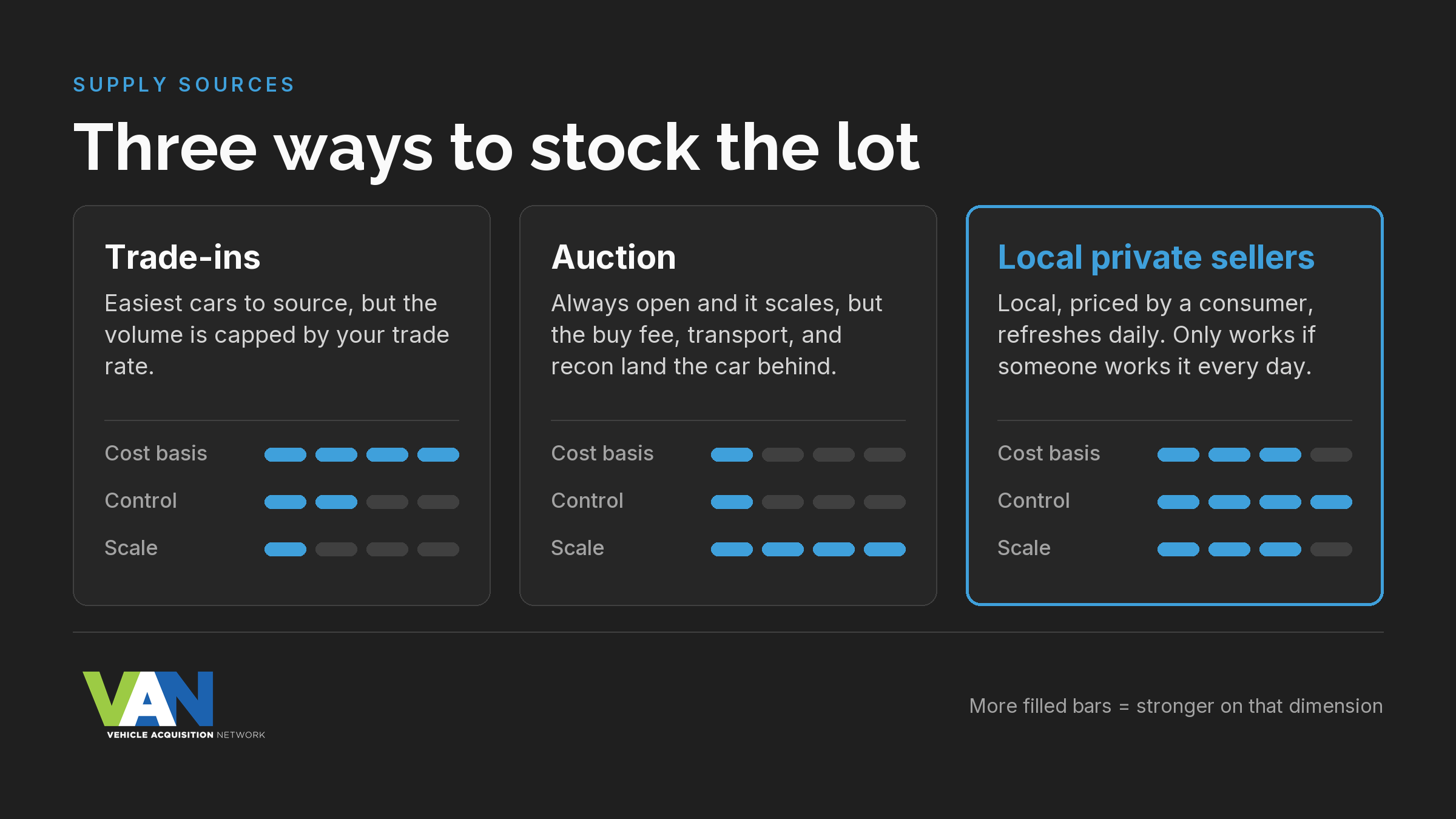
The default answer to the leftover number is the auction. It is always open, it scales, and it asks nothing new of your process. The auction is also usually the most expensive way to land a car on your lot, and the cost is easy to under-count because most of it is not the hammer price.
The landed-cost problem
The GM above was already leaning on auctions to fill the gap, and had a clear read on what it was costing him: buying at auction, he said, "cost me way too much money in shipping and recon." He landed on "local is the only way I'm going to make money," and he was talking about margin.
That's the structural issue with auction-first sourcing. The buy price is competitive because every other dealer in the country can see the same car. What differentiates your cost basis is everything bolted on afterward: the buy fee, transport, recon, and the days it burns before it is front-line ready. A car bought two states away starts its life on your lot already behind. He's not the only one: one general manager rebuilt his store's supply line without the auction and moved every department with it.
The mid-market problem
There is a second, quieter issue. The auction is deep in some segments and thin in exactly the ones that make dealers money.
The expensive units are easy to find at the auction. The band most customers finance, roughly the twenties and thirties, is the hard one, and it is the band every store in town is fighting over.
Every market has a version of this band. It is usually the segment with the shortest turn and the healthiest front-end gross, and it is usually the segment where auction supply is tightest and competition hardest. You can't volume your way out of it by bidding more often.
Why local private-party supply is the only elastic source
There is one supply pool that scales with effort rather than with budget: the vehicles listed for sale by private owners inside your own market, on consumer listing sites and online marketplaces, every day.
Three properties make it different from every other channel:
- It is local by definition. No freight bill, no week waiting on a truck, and you put eyes and a lift on the car before you write the check.
- It is priced by a consumer, not by a room full of dealers. The seller is optimizing for speed and certainty, not for the last two hundred dollars.
- It refreshes daily and it is deep in the same mid-market bands the auction is thinnest in.
The catch: you can't buy access to it. You have to work it, which is why most stores that try it casually conclude it doesn't work.
What "elastic" requires
The stores that make private-party acquisition into a reliable supply line share three things: coverage, speed, and someone who owns it. None of them are software features.
Coverage
Private-party supply is a numbers game first. In any given market, a meaningful share of listings are dealers in disguise, already sold, or unreachable. That means the funnel has to start wide: hundreds of listings reviewed weekly, not the dozen someone gets to on a slow Tuesday.
Speed
A private seller who lists a car on Saturday morning is already hearing from other buyers by Saturday night. The dealer who responds in ten minutes is having a different conversation than the dealer who responds Monday. Speed gets you into the conversation. Follow-up is what closes it.
Someone who owns it
This is where most attempts die. Acquisition gets assigned to a used-car manager who already has a full job, and it becomes the thing that happens after everything else, which means it happens on the slow days and stops entirely on the busy ones. Supply then arrives in bursts, exactly out of phase with demand.
The fix is dedicated capacity, not more discipline. We wrote about the trade-off in detail in Should You Hire a Used Car Buyer or Outsource the Work?, and what the role looks like day to day in our Vehicle Acquisition Specialist hiring guide.
Start with the gap, not with the tool
The mistake is shopping for an acquisition platform before you have sized the hole it is supposed to fill. Do it the other way around.
Calculate your monthly replenishment gap. Then ask what share of it you want coming from local private sellers within ninety days. With someone dedicated to it, a quarter to a third is a sensible first target: large enough to matter, small enough to staff. That number tells you how much coverage you need, which tells you how much dedicated capacity you need, which tells you whether you are hiring, reassigning, or outsourcing. The staffing and process side is laid out step by step in how to build a dealership buy center.
Once you have the number, VAN PACE™ turns the monthly goal into the attempts, contacts, and offers it takes each day.
Trade-ins will always be your easiest cars to source. There will also never be enough of them. Used margins have compressed, and in our experience the stores still holding gross are the ones that stopped treating the gap as a seasonal annoyance and started treating it as the number that runs the used-car department.
Replenishment gap FAQ
What is the replenishment gap?
The replenishment gap is the number of used vehicles a dealership must buy from outside sources every month because trade-ins replace only a fraction of what it retails. It is a supply problem built into the trade rate, and it widens as the store sells more, because every used unit retailed without a trade behind it deepens the hole.
How do you calculate your replenishment gap?
Pull four numbers from the last ninety days: total deliveries per month, trade capture rate (the share of delivered deals with a trade), keep rate (the share of trades you retail rather than wholesale), and used retail volume per month. Multiply total deliveries by trade capture rate by keep rate to get the trades you keep, then subtract that from used retail volume. The remainder is what you must buy elsewhere each month.
Why doesn't the auction close the replenishment gap?
Two reasons. First, landed cost: the hammer price is competitive because every dealer can see the same car, so the buy fee, transport, reconditioning, and days of age before front-line ready decide your real cost basis. Second, the auction is thin in the mid-market price bands customers finance, which are the bands with the shortest turn and healthiest front-end gross.
Why is local private-party supply considered elastic?
Private-party listings inside your own market scale with effort rather than budget. They are local, so there is no freight bill or week waiting on a truck, and you can put eyes on the car before you write the check. They are priced by a consumer who wants speed and certainty, not by a room of dealers. And they refresh daily, deep in the mid-market bands where auction supply is thinnest.
How much of the gap should come from private sellers?
With someone dedicated to the work, a quarter to a third of the monthly replenishment gap sourced from local private sellers within ninety days is a sensible first target. That share tells you how much listing coverage you need, which sets how much dedicated capacity you need, which decides whether you hire, reassign, or outsource the work.
See your market against the gap
VAN helps franchise and independent dealers build local private-party acquisition into a predictable supply line: the platform to find and work the listings, and the option of a full-time VAN Managed Buyer™ to work your market every day.
Run your four numbers, then request a demo and we will put the live private-seller supply in your market next to that gap.
Questions first? 855-952-4949.
Cover photo: David McBee via Pexels.