


Most buy centers are managed on a single number: cars bought this month. It is the right goal and a...
Vehicle Acquisition Specialist: Complete 2026 Hiring Guide

Clayton Dorris
11
min. read
Vehicle Acquisition Specialist: Complete 2026 Hiring Guide
21:13
Used-car gross is no longer won at the desk. It's won at the point of acquisition — weeks before a customer ever sees the vehicle on your lot. The dealers consistently landing cars at 95–100% cost-to-market and still making front-end money aren't finding unicorns at auction. They're buying direct from consumers, and they're doing it with one dedicated person whose entire job is to source those cars: a Vehicle Acquisition Specialist.
If you're a GM, used-car director, or dealer principal thinking about adding this role — or you've tried before and it didn't stick — this is the guide we wish every dealer had before their first hire. What the role actually is, the KPIs that matter, what to pay, how to interview, and how to decide whether to build it in-house or bring in an outside solution.
What Is a Vehicle Acquisition Specialist?
A Vehicle Acquisition Specialist (also called a private-party buyer, used-car buyer, or acquisition manager) is a dedicated employee whose sole job is sourcing pre-owned inventory directly from consumers — outside the traditional trade-in and auction channels. Why those two channels come up short is covered in The Replenishment Gap.
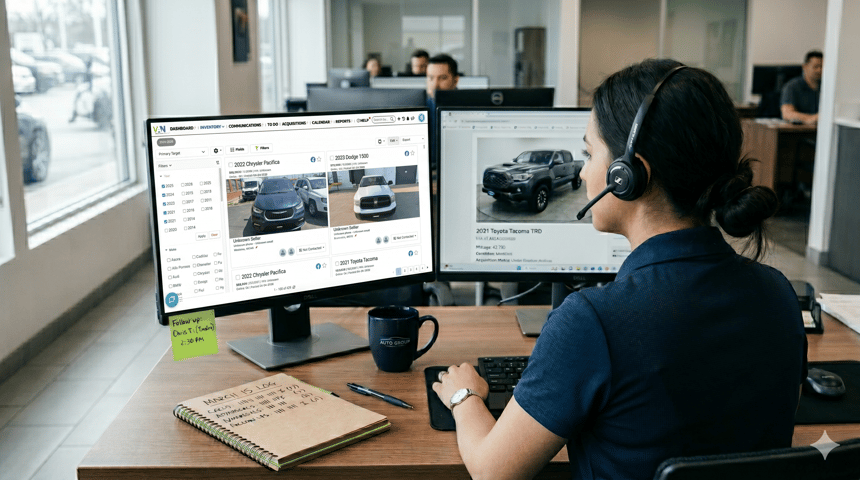
They work a pipeline of private sellers across online marketplaces and consumer listing sites, respond to inbound leads, follow up relentlessly, and turn conversations into appointments where the used-car manager appraises and closes.
The role exists because the economics of used-car sourcing have shifted. Cox Automotive and other industry trackers have shown auction volumes compressing and wholesale prices staying volatile, squeezing dealers who rely on the lane. Meanwhile, direct-from-consumer sourcing gives you:
- Higher front-end gross than auction inventory
- Fresher cars with a known history
- Lower total acquisition cost (no buy fees, no transport, no auction surprises)
- A pipeline you actually control
The Vehicle Acquisition Specialist is the person who makes that pipeline real.
What a Vehicle Acquisition Specialist Actually Does (A Day in the Life)
The job looks simple from 30,000 feet — "buy cars from people." Up close, it's a tightly choreographed process built on volume, discipline, and follow-up.
David Gavril, a buyer for a multi-franchise Midwest dealer group who buys 50+ cars every month, says this about his day:
"I start at 6:00 a.m. when the fresh leads come in — coffee at home, on the phone. I'll get to the store by 7:30. I find that I get responses without friction in the morning more so than at night."
David gets two data drops a day — one at 6 a.m., another at 3 p.m. — each delivering 60–100+ fresh listings in his 150-mile radius. He works through them in sections: greetings first, then VIN requests, then appraisals, then offers. "I just repeat the process," he says. He typically sends 15–20 firm offers per day.
Corey Mendez runs the buy center at Lakeway Auto Sales in Morristown, Tennessee. Three full-time buyers on his team bought 112 cars from private parties in a single month, 80+ of them directly from online marketplaces. Corey's day starts with a team huddle 30 minutes before open to review KPIs, then breaks into three work blocks: 9–12, 12–3, 3–6, with a touch-base meeting between each one.
A typical daily workflow looks like this:
| Time block | Activity |
|---|---|
| First hour | Reply to overnight inbound messages; work the fresh-listing data drop |
| Mid-morning | Outbound outreach — 50–150+ messages, personalized |
| Late morning | Phone calls to warm leads; move from range to firm offer |
| Afternoon | Set and confirm appointments; brief the used-car manager |
| Late afternoon | Second data drop; work follow-up funnels (5-day, 30-day, 60-day, 90-day) |
| Ongoing | Remote pickups coordinated with drivers, FaceTime walkarounds for inspection |
A common theme across every top performer: volume is the job. Corey's team tracks it to the number. In a recent 20-working-day stretch he personally logged 832 outbound contacts, 412 two-way conversations, 197 market-indicated ranges, 36 appointments set, 28 shown, and 22 bought — pacing 1.5 cars per day.
KPIs: What "Good" Looks Like for a Vehicle Acquisition Specialist
Before you hire, decide what you're measuring. The role has a clear funnel of leading and lagging indicators.
Leading indicators (daily/weekly):
- Outbound contacts per day
- Response rate to initial outreach
- Two-way conversations (contacts)
- Market-indicated ranges / offers presented
- Appointments set and appointments shown
Lagging indicators (monthly):
- Vehicles acquired per month
- Average front-end gross per acquired unit
- Cost-to-market %
- Days-to-sell on privately sourced units
One more number to track next to cost-to-market: the median offer as a percentage of the seller's asking price. In VAN's 2026 Private Acquisition Offer Strength Study the network median was 77 percent, and acquisition rate climbed with each ten points closer to asking. Here is how offer-to-asking-price percentage moves acquisition rate.
As Corey's consultant David Long tells his buyers: "It's math, not magic." You don't hit 30+ cars a month by getting lucky. You hit it by knowing exactly how many outbounds it takes to get a two-way conversation, how many conversations it takes to get a range accepted, how many ranges it takes to set an appointment, and how many appointments it takes to land a car. Then you do the math in reverse from your monthly goal. The daily targets our coaches use for that math are in buy center KPIs: the four daily numbers.
What a mature buy center looks like after 6+ months of optimization:
| Performance tier | Cars acquired/month |
|---|---|
| Below average | < 10 |
| Average | 10–15 |
| Good | 15–20 |
| Top performer | 20–30 |
| Exceptional | 30+ |
Corey's second-chair buyer Reagan bought 30 cars in his first month at Lakeway, with no prior automotive experience — because he followed the process.
Many high-performing specialists land in the 15–25 range, though market, segment, and inventory mix drive significant variation. Numbers consistently below 10 are worth a conversation about process, tooling, or market conditions.
The 7 Traits That Separate Top Vehicle Acquisition Specialists
Across every top performer we've interviewed, the same short list shows up.
1. Resilience under rejection. The closing rate on private-party outreach runs in the low single digits. Top performers take rejection without breaking stride. Normal hires slow down, stop calling, and quit.
2. Volume as a habit. David Gavril: "From a macro view, if I'm looking at 60 or 100 or 150 opportunities in a day that are coming in, I want all of them. A certain percentage are going to give me the opportunity and the rest we just push aside and go for the next one." High-volume outreach is the core of the job — specialists who can't keep pace on daily activity rarely build a consistent pipeline.
3. Phone-first communication. Text messages start conversations. Phone calls close deals. Stefany Aguilar, a Managed Buyer for a large Texas dealership: "I normally call the sellers instead of texting them — it's kind of like we can prove we are real people, not scammers."
4. Disciplined follow-up with buyer segmentation. Corey Mendez classifies every seller as either an "A-road" (ready now, just needs someone who won't waste their time) or a "B-road" (needs more time, more rapport, more market education). A-road customers get urgency and an appointment. B-road customers get released politely and worked in a long-horizon funnel. Nobody gets ignored. "Vehicles I didn't get to the number on in January, they'll reach back out in April — 'Is that offer still good?'" says David.
5. Transparency over pressure. "I'm not just a dealer. I'm not here to lowball you. My market supports paying up for cars that make sense," is the core of Corey's first message. Top specialists educate sellers with market comparables instead of grinding them. It builds trust and wins deals later.
6. Attention to detail. Top performers verify the car matches what was listed before finalizing. David's team does a FaceTime walkaround with remote sellers, runs OBD readers, checks tire tread, and claws back on undisclosed issues — respectfully and factually. "When you present it just factually, most times they just say yes."
7. Work ethic without supervision. This is the single biggest differentiator. The job is mostly desk work — messaging, calling, pipeline management. You need someone who hits the same numbers on a Tuesday morning that they hit when the GM is watching.
Why Most Dealerships Hire the Wrong Person
The #1 hiring mistake: assuming a Vehicle Acquisition Specialist is just a salesperson who happens to buy cars. They aren't. The skills and incentives don't align.
Want the field guide to this exact problem? See what most dealerships get wrong when hiring a used car buyer — and how to screen for the traits that actually predict success.
A salesperson is trained to close today. If a salesperson has to choose between working a customer who wants to buy a car this afternoon or reaching out to a private seller who might sell a car three weeks from now, the salesperson picks today. Every time. That's the comp plan working exactly as designed.
Acquisition requires the opposite temperament: long-horizon patience, consistent outreach on cold pipelines, and genuine comfort with "no."
The real cost of a wrong hire isn't lost gross — it's the cash you spent getting them in the door and the cash you'll spend getting them back out. By the time a dealer realizes a specialist isn't working out, they've typically invested tens of thousands of dollars in that hire before separating:
- Job board postings, ads, and recruiter fees (15–25% of base if you used an outside recruiter)
- GM and used-car manager hours in the interview process
- Background checks, drug screens, onboarding paperwork
- 60–90 days of base salary during ramp, much of it at sub-productivity
- Training time from existing team members
- Health benefits and payroll tax during employment
- Severance, accrued PTO payout, and unemployment insurance impact on separation
- Then the entire recruiting, onboarding, and ramp cycle starts over for the replacement
SHRM's Human Capital Benchmarking Report consistently places total turnover cost at 50–200% of an employee's annual salary. For a role with a $69,100 national average OTE, that's $34,000 to $138,000 out the door per failed hire — before you've sourced a single additional car.
Other common mistakes that lead to the wrong hire:
- Assigning it as a part-time duty. Every successful buy center we've seen has one person who owns the process full-time.
- Hiring from the desk. Desk managers and auction buyers have valuable instincts but rarely have the patience for private-party follow-up at scale.
- Under-investing in tools. Without software to surface listings, manage pipeline, automate initial outreach, and schedule follow-ups, even a strong hire burns out. Our guide to choosing vehicle acquisition software lists the five questions to ask before you buy. Weighing VAN against VETTX? See how the two compare on sources and price.
- No tracking. If your specialist can't tell you their outbound count, contact rate, and market-indicate conversion by day, they're guessing. And guessing doesn't scale.
Compensation: What Dealers Actually Pay a Vehicle Acquisition Specialist
To benchmark this honestly, we analyzed 67 live Vehicle Acquisition Specialist job postings across 25 U.S. states in April 2026. Only private-party acquisition roles were included — auction buyers, sales consultants, and trade-in appraisers were excluded.
National findings:
| Metric | Value |
|---|---|
| Average on-target earnings (OTE) | $69,100/year |
| Entry-level floor (hourly-only listings) | $15–$22/hr ($31K–$46K) |
| Top-quartile ceiling | $125K–$200K |
| Top-performer OTE average | ~$110K |
Structure varies widely:
- Hourly-only (mostly California, wage-transparency driven): $15–$22/hr
- Base + per-car bonus: $40K–$60K base + $100–$300/car
- Base + uncapped commission/OTE: $50K–$80K base, $100K–$200K OTE
- Pure commission/draw: $3K–$12K/month
The most effective plans pay a livable base (so your specialist doesn't starve during the 60 days it takes to build a pipeline) plus a meaningful per-unit bonus that scales with volume. Avoid pure commission: it incentivizes churn and bad habits. Three pay-plan templates with dollar figures are in the hiring kit.
A good Vehicle Acquisition Specialist is not "cheaper labor." They're a profit center. Pay them like one.
8 Interview Questions That Actually Predict Performance
Skip the generic "tell me about yourself." These surface the traits that matter. Score each answer with the vehicle acquisition specialist job description and interview scorecard.
- "Describe an object in this room without naming what it is." Tests their ability to clearly describe a vehicle to a seller who can't see it.
- "Walk me through the worst rejection you've ever had in a job. What did you do the next hour?" Tests resilience. Watch recovery speed, not the story.
- "How many outbound calls did you make on your best day in your last role?" Tests activity threshold. Single-digit answers disqualify them.
- "When you get a 'no,' when do you follow up next — and why?" Top performers have a system. Average performers say "depends."
- "A seller texts back: 'What's your offer?' What's your next move?" Top answer: engage, ask clarifying condition questions, then price with a range or firm offer built on real data. Anyone firing a number cold is showing you they'll give away gross.
- "Tell me about a time you changed someone's mind about something they felt strongly about." Tests the consultative, education-based approach that wins private-party deals.
- "What's your process for keeping track of 200 open conversations at once?" Organizational skills. If they don't have a system, they won't survive month two.
- "If I hire you, and in 90 days you've bought 5 cars, what's the reason?" Listen for accountability vs. blame-shifting. Top performers own the number.
When Building In-House Makes Sense
Before we get to the build-vs-outsource comparison, it's worth stating plainly: plenty of dealerships run excellent in-house Vehicle Acquisition Specialist programs. The in-house path is often the right call when:
- You're a larger dealer group with HR infrastructure. Groups with dedicated recruiters, trainers, and onboarding systems absorb the hiring overhead that kills this role at single-point stores.
- You have a strong local talent pool. Some markets (particularly mid-size cities with university pipelines or a high density of former bartenders, realtors, and phone-heavy reps) produce candidates who take to this role naturally. Corey Mendez and Reagan at Lakeway are two examples of zero-auto-experience hires who became top performers with good coaching.
- You already have BDC or phone-room infrastructure. If you're running a mature BDC, adding a Vehicle Acquisition Specialist alongside it is a small incremental lift. You already have the desks, phones, CRM seats, and management rhythm.
- You want full control over pay plan, brand voice, and seller experience. An in-house buyer is on your masthead. Everything they say to a seller reflects your store directly. Some dealers — particularly luxury franchises and independents with strong local brands — prefer that control.
- You're committed to coaching and retention. Dealers who treat this as a full career path — with mentorship, KPI reviews, escalation paths to used-car manager — get 2–3 year tenures and compounding results. Dealers who treat it as a "hire and forget" role burn through four specialists in two years.
- Your volume justifies the fully-loaded cost. If a good in-house buyer is landing 25+ cars/month at $2,500+ front-end gross, the math on a $10K/month loaded employee is comfortable. Volume matters.
If that list describes your dealership, building in-house is probably the right move. The rest of this post will help you do it well.
Build In-House or Outsource? The Honest Comparison
For dealers who don't check most of the boxes above — or who've tried in-house and churned through hires — a managed or outsourced acquisition buyer is worth evaluating.
When you factor in the full loaded cost of an in-house hire — base compensation, benefits, tools, and overhead — the math often surprises dealers.
What an in-house Vehicle Acquisition Specialist really costs per month:
| Line item | Monthly |
|---|---|
| Base OTE ($69,100/yr ÷ 12, national average) | $5,758 |
| Benefits load @ 29.9% (health, payroll tax, PTO, retirement) | +$1,722 |
| Acquisition software, CRM, appraisal tools, workstation | +$1,695 |
| Loaded monthly cost — average performer | $9,175 |
| Loaded monthly cost — strong performer at $90K OTE | $11,440 |
| Loaded monthly cost — top performer at $110K+ OTE | $13,600+ |
Not included: recruiting fees ($10K–$22K one-time if using a recruiter), 60–90 day ramp time at sub-productivity, and turnover replacement costs.
Side-by-Side Comparison
| In-house specialist | Outsourced Buyer | |
|---|---|---|
| Recruiting time | 30–90+ days | Typically under 2 weeks |
| Ramp time | 60–90 days to hit benchmark | Working your market from day one; most partners buy their first car within 30 days |
| Training | On the dealer | Included |
| Turnover risk | High — the role burns out average hires | Replacement handled by the provider at no additional hiring cost |
| Bilingual capability | Depends on local hire | Commonly available |
| Full-time commitment | Yes, with full overhead | Yes, without the overhead |
| Control over pay plan / brand voice | Full | Shared with provider |
| Monthly cost | ~$9,200–$13,600 loaded* | $5,995 per month (VAN Managed Buyer) |
*Source for in-house cost: VAN 2026 Vehicle Acquisition Specialist Compensation Study — proprietary analysis of 67 live job postings across 25 U.S. states (April 2026). National average midpoint on-target earnings: $69,100/year. Benefits load per U.S. Bureau of Labor Statistics Employer Costs for Employee Compensation, Q4 2025. Software and tooling estimate based on VAN Professional tier. All postings verified as private-party acquisition roles.
Neither path is universally better. The right answer depends on your group's size, hiring pipeline, market, and appetite for operational overhead. For some dealers, a managed solution shortens the path to a running buy center without the hiring and ramp risk. For others, building the buy center in-house, with the right coaching and tools, produces a specialist who becomes a long-term profit center.
Frequently Asked Questions
What is a Vehicle Acquisition Specialist?
A Vehicle Acquisition Specialist is a dedicated dealership role focused on sourcing used vehicles directly from private sellers — not from auction or trade-in — by managing outbound outreach, follow-up, and appointment-setting with consumers looking to sell their cars.
How much does a Vehicle Acquisition Specialist make?
Based on VAN's April 2026 analysis of 67 live job postings across 25 states, the national average on-target earnings is $69,100 per year. Top performers in high-comp markets (Texas, Washington, Arizona) earn $110,000–$200,000. Entry-level hourly-only listings range from $15–$22/hour.
How many cars should a Vehicle Acquisition Specialist buy per month?
It varies by market, segment, and inventory mix. Many high-performing specialists land in the 15–25 range after 6+ months of optimization. Average performers land at 10–15, and exceptional buyers exceed 30.
Is a Vehicle Acquisition Specialist the same as a used-car buyer?
Functionally yes, though "used-car buyer" sometimes refers to auction-lane buyers. Vehicle Acquisition Specialist specifically refers to private-party-focused buyers sourcing directly from consumers.
Can a salesperson do this job part-time?
Rarely successfully. The incentive structures pull salespeople toward today's buyers, not next month's sellers. Dedicated specialists consistently outperform part-time arrangements.
What tools does a Vehicle Acquisition Specialist need?
At minimum: an acquisition platform that surfaces private-party listings and manages the pipeline, an appraisal tool, CARFAX or AutoCheck access, and a DMS integration. Without purpose-built software, even a strong hire will drown in manual work.
Whichever Path You Choose, VAN Can Help
If you're hiring in-house, the vehicle acquisition specialist hiring kit has three pay-plan templates, a job description you can post, the interview scorecard, and a 30/60/90 plan, on one page with no form.
Open the Hiring Kit
If you're evaluating an outsourced solution, VAN's Managed BuyerTM program places a trained, bilingual-capable buyer on your pipeline in about a week — no job posts, no interviews, no ramp.
Book a Demo