

Buy Center KPIs: The Daily Numbers That Predict Next Month's Cars


Most buy centers are managed on a single number: cars bought this month. It is the right goal and a terrible management tool. By the time it tells you something is wrong, the month is over and the pipeline that would have fixed it was never built.
The stores that buy consistently manage the leading numbers instead, the daily activity that produces next month's acquisitions. The four daily buy center KPIs our Acquisition Coaches™ hold dealers to are 100 listings reviewed, 10 to 13 offers made, 40 to 60 follow-up tasks completed once the pipeline is built, and 2 to 3 appointments set once the pipeline is built. Those are the standards we coach to. Here is what "good" looks like on each and the failure each one catches early.
The four daily numbers, per dedicated buyer
- Listings reviewed: 100
- Offers made: 10 to 13
- Follow-up tasks completed: 40 to 60, once the pipeline is built
- Appointments set: 2 to 3, about 60 a month
The monthly funnel behind those daily numbers: 3,000 outbound touches (new and follow-up), 1,200 conversations, 300 offers, 60 appointments, 12 to 18 cars once a buyer is ramped.
Number 1: Listings reviewed per day, target 100
Coverage is the top of the funnel and the number most stores are quietly failing. The standard I hold a full-time buyer to is 100 listings reviewed per day. That count includes the day's follow-up touches; fresh listings fill whatever the task list leaves. Most part-time efforts are reviewing ten or fifteen and wondering why the results are erratic.
As I put it to a buyer on a check-in this spring: "my buyers internally are supposed to be looking at a 100 listings a day. 100. One, zero, zero."
What counts as "reviewed"
Reviewing is a fast qualification pass on each listing:
- Open it and scroll the photos
- Read the description for condition, title status, and history signals
- Judge whether it is a genuine private seller or a curbstoner, a dealer posing as one. The backdrop in the photos usually settles it
- Then either message the seller or pass and move on
Done properly that is roughly ninety seconds. I am deliberately unglamorous about it: "if you think about it, you click on it, you go through the pictures, it might take you a minute and a half to do that."
So 100 is about two and a half focused hours of work. If your buy center cannot hit it, someone is doing acquisition around the edges of another job.
What low coverage is telling you
A store stuck at 30 listings a day has a capacity problem. The fix is structural: protect the time, or move the work to someone whose whole job it is.
Number 2: Offers made per day, target 10 to 13
Coverage is the input. Offers are the first real output. Against 100 listings reviewed, I hold a buyer to 10 to 13 offers per day.
Managers routinely expect that ratio to be better, and set targets accordingly. It is low for a structural reason: in our experience most listings do not include a VIN, so the buyer cannot value the vehicle until the seller supplies one. A large share of each day's outbound messages are requests for a VIN or plate so an offer becomes possible.
This is why we talk dealers down from aggressive offer goals. When one store proposed a 20-a-day target, my answer was that 20 "just seems pretty high in the sky, and I'm not sure if it's necessarily the most attainable."
Ten to thirteen is the honest band, and over a working month the top of that band is the 300 offers in the funnel. An unreachable number teaches a new buyer that the scoreboard is fiction, and that is the fastest way to lose them in week three.
Number 3: Follow-up tasks completed, 40 to 60 per day once the pipeline is built
With a pipeline underneath them, a working buyer is carrying 40 to 60 follow-up tasks a day. Every seller who did not answer, every "let me think about it," every car still listed three weeks later: each becomes a scheduled touch.
Track completion, not creation. A task list that grows faster than it is worked is a rotting pipeline. The reason the count matters: in our coaching, buyers plan on eight attempts before a seller answers. Five, six, or seven touches is fine. Eight and above is where the odds change, so a buyer who stops at three has done the work and skipped the payoff.
The trap inside this number
This is where buy centers break, and from the outside it looks like a busy, diligent buyer. The failure mode is follow-up crowding out prospecting, and I say it on nearly every check-in:
"So often I've seen dealerships get tied up in their follow-up where it's like they leave zero time in their day to reach out to new, fresh prospects. And that's just as important."
A buyer who spends the whole day on follow-up feels productive and is starving the top of the funnel. The damage shows up in the month after next.
The fix is scheduling
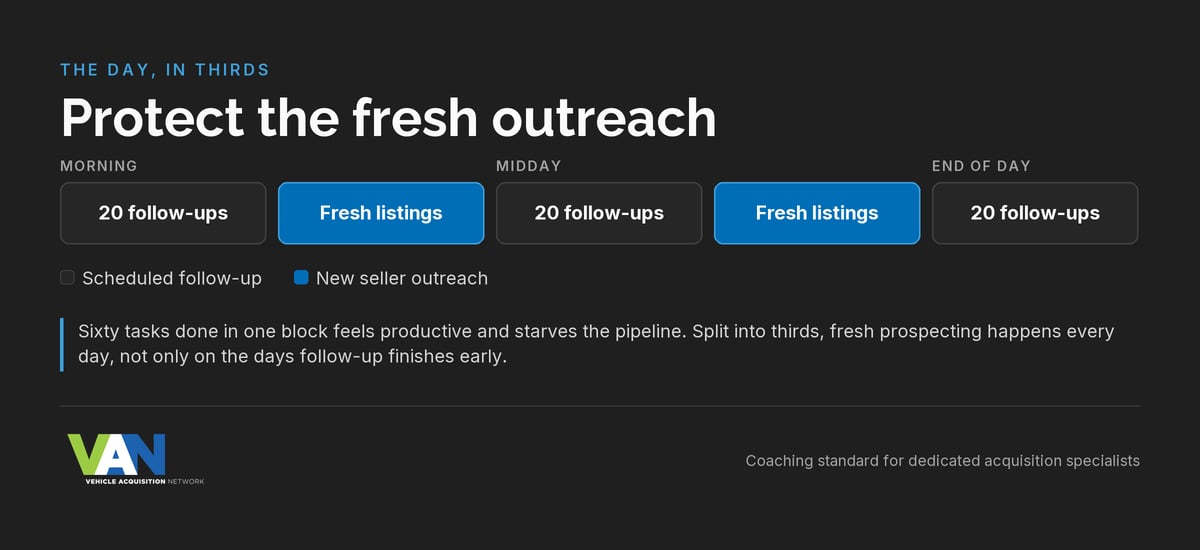
Split the day's follow-up into three blocks, morning, midday, and end of day, and use the gaps for fresh outreach. Sixty tasks becomes twenty, twenty, and twenty, with new listings in between.
It keeps the monotony survivable, and it guarantees fresh prospecting happens every day rather than only on the days follow-up finishes early, which is never.
Number 4: Appointments set per day, target 2 to 3
Coverage, offers, and follow-up all serve one output: a seller standing in front of your used-car manager. That is the handoff point where your normal process takes over.
The monthly buy center funnel VAN coaches dealers to runs 3,000 outbound touches to 1,200 conversations to 300 offers to 60 appointments. Over roughly 24 working days that is 2 to 3 appointments set a day, and it is where 12 to 18 cars a month comes from once a buyer is ramped. Read it on the 15th: 30 set so far means the month is tracking to plan, and a buyer sitting at 15 set is a month that will land at about half.
The most common coaching correction here has nothing to do with effort. New buyers try to settle price over text. The seller names a number, the buyer counters, and forty minutes vanish into a negotiation that was never going to close remotely.
The instruction we give is to move to the appointment as fast as the conversation allows: "to move to the appointment as quickly as possible so that you're not wasting all of your time negotiating and fighting back and overcoming objections ... it's more important to have them in the store in front of you because you have a higher chance at converting them."
A firm number requires seeing the car. "Here's a range, let's confirm it in person" is both the higher-converting move and the straighter one. Where that range should sit against the asking price is in how much to offer a private seller.
What the buyer should be selling
Your competition is the private sale the owner is already attempting: strangers texting at midnight, no-shows, haggling in a parking lot, and a payment method nobody trusts.
The pitch that converts is convenience: we can look at it today, pay you the same day on a clear title, get you a ride home, and have you out in about thirty minutes. Sellers assume a dealership visit costs them half a day. Removing that assumption removes the main reason they stall.
How to read the four buy center KPIs together
Individually each metric is noisy. Together they localize the problem fast:
- Low listings, everything else fine: a capacity problem. Acquisition is being done around another job.
- Listings fine, offers low: a qualification or messaging problem. The buyer is reviewing but not engaging, or not getting VINs.
- Offers fine, appointments low: the buyer is negotiating over text instead of moving to the store.
- Appointments set, cars not bought: check show rate first, then look downstream at appraisal and the in-store experience, not at the buyer.
That last row matters. Plenty of buy centers get blamed for a problem that lives in the appraisal.
Set the ramp expectation before you set the target
The stores that struggle are usually the ones that set the target before they set the ramp.
For a single dedicated buyer, the goal I set for month one is three to five acquisitions; across our launches the first month averages about four. During that ramp the buyer is learning the market, building a follow-up book, and finding out which segments the store can price.
The follow-up book is why patience pays. The sellers who said no in month one are the ones who come back in month three. That is what the follow-up book is for. Judge a buyer solely on their first thirty days and you will cut them right before the pipeline they built starts paying out. The month-by-month curve is in the first 60 days of a buy center launch, and the 30/60/90 onboarding plan in the vehicle acquisition specialist hiring kit sets the same checkpoints.
If the activity numbers above are unreachable in your store today, the usual reason is that nobody owns acquisition full-time. That is a staffing decision. We covered what the role is, what to pay, and how to interview for it in the Vehicle Acquisition Specialist hiring guide, the supply math behind why the function exists at all in The Replenishment Gap, and the build itself in how to build a dealership buy center.
Buy center KPI questions
How many listings should a vehicle buyer review per day?
The standard VAN's coaches hold a full-time buyer to is 100 listings reviewed per day, and that count includes the day's follow-up touches. A review is a fast qualification pass: open the listing, scroll the photos, read the description for condition, title status, and history signals, judge whether the seller is genuinely private, then message or pass. At roughly ninety seconds each, 100 listings is about two and a half focused hours.
What are the four daily buy center KPIs?
The four daily KPIs VAN's Acquisition Coaches™ hold dealers to are listings reviewed (target 100 per day), offers made (10 to 13 per day), follow-up tasks completed (40 to 60 per day once the pipeline is built), and appointments set (2 to 3 per day, about 60 a month). They come from the monthly funnel VAN's coaches work to: 3,000 outbound touches, 1,200 conversations, 300 offers, 60 appointments, and 12 to 18 cars once a buyer is ramped.
Why is the offer target only 10 to 13 per day against 100 listings?
In VAN's experience most listings do not include a VIN, so the buyer cannot value the vehicle until the seller supplies one. A large share of each day's outbound messages are requests for a VIN or plate so an offer becomes possible. Managers routinely expect a better ratio, but an unreachable target teaches a new buyer that the scoreboard is fiction, which is the fastest way to lose them in week three.
How should a buyer schedule follow-up so it does not crowd out prospecting?
Split the day's follow-up into three blocks, morning, midday, and end of day, and use the gaps for fresh outreach. Sixty tasks becomes twenty, twenty, and twenty with new listings in between. Track task completion, not creation. A buyer who spends the whole day on follow-up feels productive but is starving the top of the funnel, and the shortfall shows up the month after next.
How many cars should a new buy center buyer acquire in month one?
For a single dedicated buyer, the month-one goal VAN's coaches set is three to five acquisitions, and across VAN launches the first month averages about four. During that ramp the buyer is learning the market, building a follow-up book, and finding out which segments the store can price. The sellers who said no in month one come back in month three, so judging a buyer on the first thirty days cuts them before that pipeline pays out.
Run these four numbers on your store
VAN gives buy centers the platform to find and work private-seller listings across the market, and Acquisition Coaches™ who train to these standards.
If dedicating a full-time person is not the right move, a VAN Managed Buyer™ works your market on the store's behalf.
VAN PACE™ tracks offers, appointments, and purchases per buyer per day against a monthly goal, so two of the four numbers above are read every morning instead of discovered at month end.
Pace Check™ can deliver those numbers to your inbox three times a day; ask your coach to turn it on.
Request a demo and we will show you the live private-seller supply these numbers work against in your market.
Or call 855-952-4949.
Quotes are from my own dealer check-in calls, lightly edited for clarity. Cover photo: Kampus Production via Pexels.