


{% video_player "embed_player" overrideable=False, type='hsvideo2', hide_playlist=True,...

Tom Gregg
5
min. read

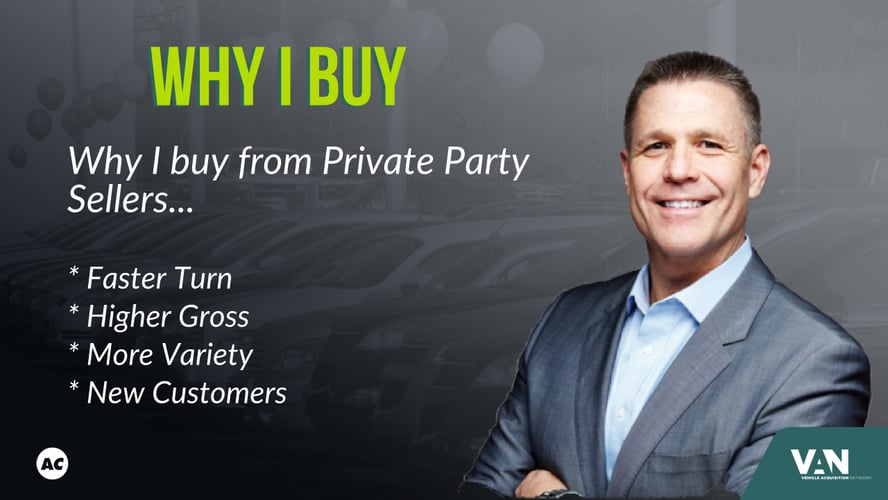
A used car bought from a private seller grosses about $3,525 for dealers on VAN. The same kind of car bought at auction grosses about $1,050. That gap is why stores build a buy center. The hard part isn't deciding to do it. It's the person in the seat: who you hire, what you pay them, and what happens when they quit. Here's how Tom Gregg, VAN's CEO, tells dealers to build one, and the three ways to staff it.
"Somebody who is working private sellers is often a different skill set than somebody that's buying from the auction. If a dealer is really looking to set up a buy center, it has a different human capital cost than somebody that's looking to buy three to five cars from the public."
Tom Gregg, CEO, Vehicle Acquisition Network
What Is a Dealership Buy Center?
A dealership buy center (some dealers say buying center) is a dedicated team inside the store that buys used cars directly from private sellers instead of relying on trade-ins and the auction. Its job is a lower cost-to-market on retail-ready units. The auction is a separate desk with a different skill set, which is Tom's point above.
NADA Data 2025 puts street purchases at 9.1% of the used inventory franchise dealers retail, against 21.9% from auction and 69% from trades. Most stores already run the passive channels: trades, service-drive appraisals, and instant-cash-offer leads from the website. The buy center adds the outbound one. Route inbound seller leads to the same buyer and the same process so nothing gets worked twice.
How Do You Build a Buy Center at a Dealership?
Most dealers don't stall on the idea. They stall on the rollout. Here's the order that works, from the first decision to a buyer writing offers.
- Set a number and a ceiling. Decide how many cars a month you need from the private channel and the cost-to-market you'll accept on every offer. Without a number you can't tell if the center is working. Without a ceiling the pay plan rewards cars you can't retail.
- Put someone in the seat, then set the pay plan and offer authority. One person makes offers, one sets appointments and inspections. In a small store that's the same person. As you scale it becomes a team, and the traits that predict a strong buyer matter more than a car-business resume. Per-car pay plans are common; whichever you choose, pay on cars bought and retailed, not offers made. Give the buyer a band they can write without a manager and a hard cost-to-market ceiling above it, so the conversation doesn't die waiting on the desk. If you're hiring, start with how to hire a vehicle acquisition specialist. The pay plans and job description are in the vehicle acquisition specialist hiring kit.
- Give them a process, not just a phone. Word tracks, an offer template, and a follow-up cadence, plus the back-office pieces most first-timers skip. Most private-party cars carry a lien, so brief the title clerk on payoff letters, ten-day payoffs, and out-of-state titles before the first seller shows up, or the car sits untitled while it ages. Have the used-car manager set a recon estimate standard, because a shop that pads every estimate kills offers. Tell the service drive these cars are coming; a buy center with no lift time for inspections stalls in week three. That repeatable process is what keeps the pipeline running after a buyer quits.
- Put the right tools in front of them. A buyer should spend the day talking to sellers, not chasing spreadsheets. Buy center software that runs sourcing, seller follow-up, and offer tracking keeps it in one place. Before you buy any of it, read the four things acquisition software must do.
- Pick where you'll source. Sellers don't list in one place. VAN pulls private-seller listings from 25+ online marketplaces, so the same seller shows up wherever they posted.
- Track activity before results. Calls, offers, and appointments tell you the pipeline is healthy weeks before the cars arrive. Month one at a new store averages about 24 appointments set, about 16 shows, and 4 to 6 cars bought. VAN PACE™ reporting puts those activity numbers in front of you daily. For the week-by-week picture, see the first 60 days of a buy center launch.
What Does the Buyer Seat Cost?
A buy center is a payroll decision before it's a software decision. You're hiring someone who can close a stranger on the phone and hold an offer, and that's a different hire than the person who works your auction lane. You have three ways to cover the seat. A BDC isn't one of them; here's the difference between a BDC and a buy center.
| In-house buyer | Outsourced buyer | Auction only | |
|---|---|---|---|
| What you pay for the car | The private-party price, no buy fee, no transport | The private-party price, no buy fee, no transport | Lane price plus buy fee and transport, with every dealer in the lane bidding against you |
| Who hires and trains | You | The vendor | You still need someone running the lane |
| Turnover risk | On you | Vendor refills the seat | Still on you; the manager who knows the lanes is one person |
| Time to first cars | Recruit, train, then load the pipe | Month one; the buyer is trained, the pipeline still loads | Same week |
| Monthly cost | Pay plan, benefits, manager time | VAN Managed Buyer™ is $5,995 a month, buyer and coaching included | Buy fee plus transport, per car |
| Gross per car (dealers on VAN) | About $3,525 on a private-party car | About $3,525 on a private-party car | About $1,050 |
| Days to turn | About 31 | About 31 | 43 |
Hiring in-house gives you full control if you have the bandwidth to recruit, train, and absorb the turnover that sinks most acquisition teams. If you'd rather not carry that risk, you can outsource the buyer role to VAN Managed Buyer™: a trained buyer works your seller leads under your store's name, and VAN handles recruiting, ramp, backup coverage, and turnover.
Whichever seat you choose, VAN backs it with a dedicated Acquisition Coach™. See what VAN costs per month. Buying only at the auction is the third option, and usually the most expensive once fees and transport are counted. Many stores start outsourced to prove the channel, then hire in-house once volume passes what one buyer handles.
Buy Center FAQ
How much does it cost to start a buy center?
The biggest cost is the buyer. An in-house buyer costs a pay plan plus recruiting and training time, a desk and phone, and lift time for inspections. The software that runs sourcing, follow-up, and offer tracking is $1,695 a month (VAN Professional) or $2,495 a month (VAN Accelerate). A fully outsourced buyer through VAN Managed Buyer™ is $5,995 a month and covers the person, the software, and the coaching.
How many people do I need to run a buy center?
One dedicated buyer to start. A ramped buyer does 12 to 18 cars a month, so one seat covers a small store. Add an appointment setter when the follow-up list outgrows the phone hours, and a manager once you run more than one buyer.
Should I hire a buyer or outsource the role?
Hire in-house if you can recruit, train, and absorb turnover, and you want the seat under your roof. Outsource if you want a trained buyer producing in month one without the hiring risk. Many stores start outsourced to prove the channel, then hire in-house once volume passes the 12 to 18 cars a month one buyer handles.
Is buying from private sellers cheaper than the auction?
Usually. Auction cars carry a buy fee, transport, and a lane price set by other dealers bidding against you. Dealers on VAN average about $3,525 gross per private-party car versus about $1,050 on auction cars, and private-party cars turn in about 31 days versus 43 for auction. Lithia reported $2,483 front-end gross on customer-sourced cars versus $700 to $800 on auction cars on its first-quarter 2026 earnings call.
How long does it take to launch a buy center?
A buy center buys its first cars in month one. The first two weeks load the pipeline; the buys land in weeks three and four. Month one at a new store averages about 24 appointments set, about 16 shows, and 4 to 6 cars bought. Elk Grove Subaru grew from 35 to 86 used cars a month once the seat and the process were in place.
Tom's short version: decide the number, put one person on the phone with a process, and track calls and offers before you track cars. The cars follow.
Book a buy center demo, or call 855-952-4949.