


If you want to be buying at full speed when refund checks land, your buy center has to start in...
Buy Center Goals: Plan the Year, Then Track the Pace

A buy center's annual goal should start with the number of cars the store needs, not the number it bought last year. Work it down to a monthly target for each buyer, then to the daily activity that produces it, and track pace every week so a slow month shows up while it can still be fixed.
Nearly every store that misses its acquisition number had a goal. Few had a daily routine that adds up to it, or a way to see the month slipping before the 30th.
The short version
- Start from the gap: the cars your store needs each month that trades and lease returns don't cover.
- Vehicle Acquisition Network (VAN) sets a monthly goal of 17 cars for a ramped, dedicated buyer, built on 2,000 attempts, 800 seller conversations, 200 offers and 30 appointments.
- Plan the ramp. A new buyer's first month lands at three to five cars.
How do you set a buy center's annual goal?
Set the annual goal from the store's replenishment gap. Take your expected used retail for each month of next year, subtract what trades and lease returns usually supply, and the difference is what every other source has to cover. The replenishment gap shows the math.
Then decide how much of that gap private sellers should fill, and set it month by month. Spring needs more cars than December, because tax refund season historically pushes used retail to its peak in March or April, according to Cox Automotive. We covered that timing in buying used cars for tax season.
How many buyers does a buy center need?
Divide the monthly private-seller target by what one ramped buyer is expected to buy. VAN sets a monthly goal of 17 cars for a ramped, dedicated buyer, so a store that needs about 34 cars a month from private sellers plans for two buyers, and treats 17 each as a goal, not a guarantee.
Build the ramp into the plan. A new buyer's first month usually lands at three to five cars, and the 17-car goal depends on a follow-up book that takes months to build. If you're adding a buyer for spring, the hire goes in the plan for November or December.
How do you turn a yearly goal into daily work?
Turn a yearly goal into a monthly funnel for each buyer, then into daily work. VAN's monthly goals for a ramped buyer, the same goals our Managed Buyers™ work to, are:
| Stage | Monthly goal per buyer |
|---|---|
| Outreach attempts | 2,000 |
| Seller conversations | 800 |
| Offers | 200 |
| Appointments set | 30 |
| Appointments shown | 22 |
| Cars acquired | 17 |
Those are goals. Results vary by market and buyer. Each stage is a conversion rate, so when the month comes up short you can see which stage narrowed. The four daily numbers behind them, and the failure each one catches, are in buy center KPIs.
Comedian Jimmy Carr made the case for routine over targets in a September 2026 clip: "Your systems beat goals every time. Craft and graft beat talent. You will not be out-talented. You will be out-worked." Graft is British slang for hard work, and a buy center runs on it. Nobody hits 17 cars with a big last Friday of the month. A buyer gets there by reviewing 100 listings, making eight or nine offers and working the follow-up list every day.
How do you connect a buy center's goals to its process?
Connect a buy center's goals to its process by writing the process down and tracking daily activity against it. The written process is what the store says it does. The KPIs show what it actually does. The goal sets how much of that work the month needs. A missed month usually traces back to a step in the process that stopped happening, and the numbers show where to look.
A buy center's written process should cover:
- What to buy: model years, miles, price range and the makes the store wants most.
- What to stay away from: branded titles, frame damage and anything else the store won't retail.
- How far to go: the search radius, and who approves a car outside it.
- How offers work: which appraisal tool the store uses, who approves the final number, how long an offer is good for, and that every offer depends on seeing the car.
- The follow-up schedule: how often the buyer reaches back out, and when a seller moves to long-term follow-up.
- The appointment: the hours, what the seller brings (title, ID, both keys and payoff information), how a payoff is handled and how the seller gets paid.
If yours isn't written down, one page covers it. Put one manager's name on it, go over it with your managers every quarter and note what changed and why. When pace slips, check the process before you touch the goal. If the cars bought don't fit the buy box, or follow-ups are running behind schedule, fix the routine and leave the target alone. The steps for setting that process up are in how to build a dealership buy center.
How do you know if a buy center is on pace?
A buy center is on pace when month-to-date activity matches the goal at each stage. Check it at least weekly. The mid-month read shows what a buyer's numbers on the 15th mean for the month.
VAN PACE™ is VAN's goal and pace reporting. You set goals per buyer and per month, each stage chained by conversion rate, and the dashboard shows the goal, where the store is against it and the projected finish for the month.
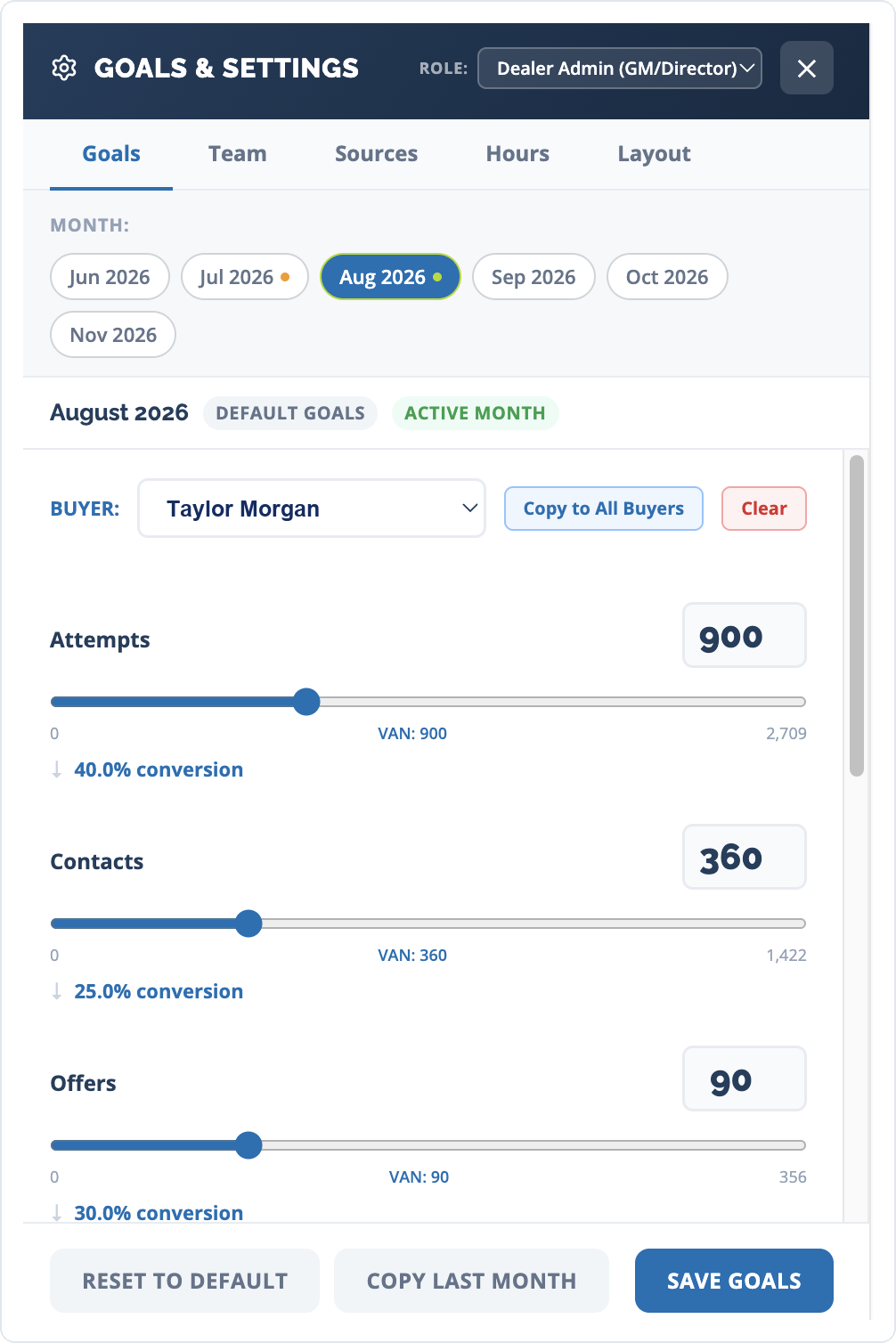
Per-buyer, per-month goals in VAN PACE™. Sample buyer shown.
Pace Check™ puts those numbers in the inbox three times a day, so nobody has to remember to open a dashboard. The morning Check-In shows where the store stands and what today needs. The midday Check-Up shows whether the day is on track while there's time to adjust, and the end-of-day Check-Out shows what happened. Ask your Acquisition Coach™ to turn it on.
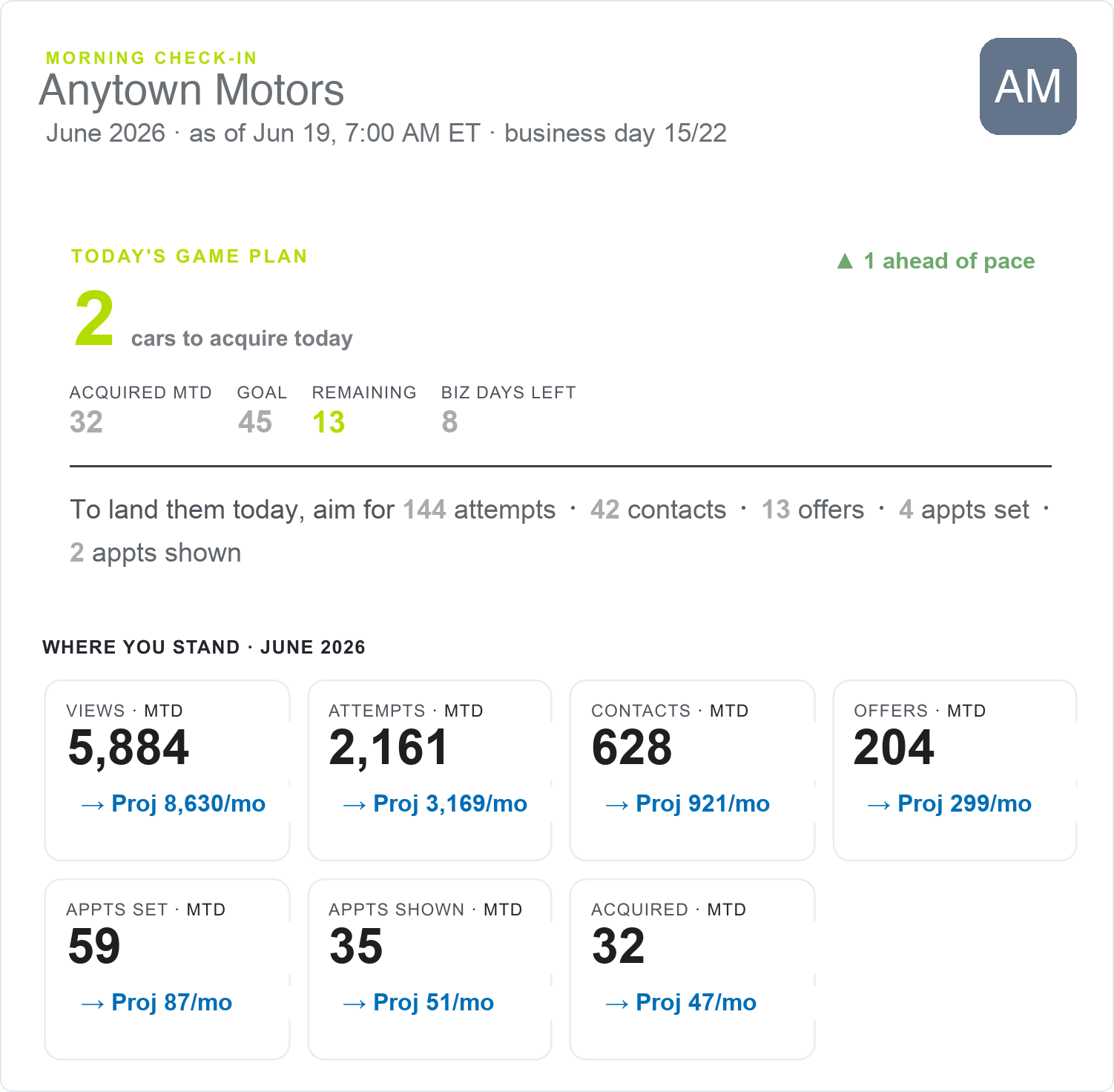
A morning Check-In for a sample store.
What should a buy center review each quarter?
Each quarter, a buy center should review the inputs behind the plan: the written process, how each buyer is ramping, conversion at each stage, the replenishment gap and next year's hires. The monthly forecast keeps running, and the quarterly review is where the plan itself changes.
- Q1 (January to March): Tax season. Is every buyer ramped, and is the follow-up book big enough to carry March?
- Q2 (April to June): Compare actual conversion at each stage to the goals. Fix the stage that narrowed before raising the target, and reset what you pay if values come off the spring peak.
- Q3 (July to September): Re-run the replenishment gap with half a year of real numbers.
- Q4 (October to December): Set the next year's goals and decide on hires early enough to ramp before spring.
Frequently asked questions
What is a replenishment gap?
A replenishment gap is the number of used cars a store needs each month that its trades and lease returns don't supply. It's the number every other acquisition source, private sellers included, has to cover, and it's the right starting point for a buy center's annual goal.
Should a new buyer carry the same goal as a ramped buyer?
No. Set month one at three to five cars and raise the goal as the follow-up book builds. VAN PACE™ sets goals per buyer and per month, so a new buyer and a ramped buyer can carry different targets on the same team.
How often should a buy center check pace against its goal?
At least weekly. Compare month-to-date activity to the goal at each stage, so a slow week shows up while there's still time to fix it. Stores that want a daily read can turn on Pace Check™ emails, which send each buyer's numbers three times a day.
When should a dealership set next year's acquisition goals?
In the fourth quarter. Any new buyer needs a few months to ramp, so a store that wants full output by tax season in March has to decide on the goal and the hire in November or December.
Next step
Book a demo or call 855-952-4949, and we'll show you how VAN PACE™ tracks a buyer's pace against the goals you set.
Sources: Cox Automotive, February 2024 used retail sales; Jimmy Carr, "It's all about craft and graft" (YouTube).