
![3 Keys to Success Buying Used Cars from Private Sellers [VIDEO]](https://www.buywithvan.com/hs-fs/hubfs/Imported_Blog_Media/van-video-thumbnail-showplate-bill-jonah-alt.png?height=500&name=van-video-thumbnail-showplate-bill-jonah-alt.png)
Most dealers have been suffering from the auctions for quite a while, eating at their profits....
used car strategy,
used vehicle acquisition,
Best Practices,
carmax,
Strategies and Tips,
Used Car Business
What Carvana's Consumer Vehicle Acquisition Strategy Proved

Tom Gregg
3
min. read
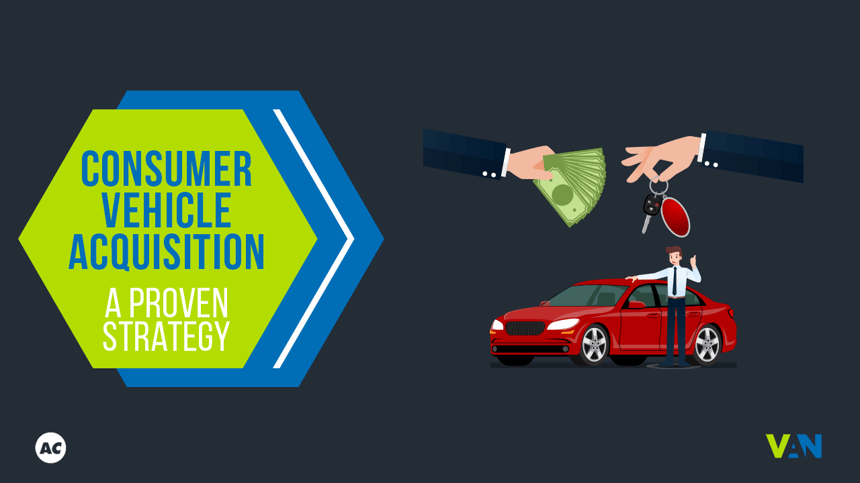
In 2018, Carvana sold roughly 100,000 cars and bet it could reach two million a year. Whatever you think of Carvana, one part of its bet has been settled: buying cars directly from consumers works at scale. The strategy was simple. Buy used inventory straight from private sellers instead of competing for it at auction.
CarMax proved the channel first, backed by more than 200 stores whose highly profitable wholesale business runs on a consumer vehicle acquisition strategy. Carvana proved a newer version, built on reaching private sellers where they already are. And every car either of them buys from a private seller in your market is a car your store didn't get a shot at. Dealers don't need either company's infrastructure. The channel both bet on is open to any store with the right process. Here is how the bet looked when it was placed, in 2019, and what it still teaches.
“We don’t play dealership games” was the mantra. The company was not yet profitable at the time, and pivots like this drew attention.
In a 2019 conversation, industry veteran Ed French responded, “Absolutely! Carvana is a disruptor,” when asked if franchise dealers should be concerned about this play.
French said, “This new acquisition strategy is purely a play to get a cost advantage. They’ve had to go to the street like everybody else but they haven’t had the luxury of new car franchises to acquire trades. They’re having to acquire them through normal traditional channels, and there’s just no juice in that squeeze.”
At the time, Carvana was burning about $50M a quarter. It had sold approximately 100,000 cars in 2018 and wanted to be selling 2M cars a year within a few years. To do that it needed inventory, and with an average loss of $800 per car according to French, it needed to acquire more vehicles while becoming more profitable.
Enjoy the Preview
Follow the Leader in Consumer Vehicle Acquisition
And who better to look to than CarMax. In contrast, CarMax sold more than 770k vehicles in 2018 and was earning about $200M in quarterly profit, per its 2018 Q3 results. The company, founded in 1993, buys everything. And with more than 200 locations nationwide, one advantage CarMax held over all others was its wholesale platform.
CarMax’s Wholesale Platform Advantage
According to French, CarMax at the time wholesaled about 100,000 cars a year, internally and externally, and profitability on its wholesale business was “outstanding.” CarMax retail outlets can wholesale vehicles from location to location without the typical auction costs competitors face.
Carvana saw this, and understood that it needed the same advantage to compete and be profitable.
Simplifying the Sale
On the surface, Carvana’s message to consumers was that it provided not just an alternative to the traditional dealership experience, but a better experience all together. This applies not only to buying a car, but also selling your car to Carvana. As Carvana described on its blog at the time:
In addition to providing car buying customers with an online solution to purchasing and trading in their vehicles, we also allow customers to sell their vehicles outright without the stress, anxiety, and time spent that comes with attempts to sell privately or to a dealership.
If Carvana wanted to profit, it could not risk offering more on vehicles than they were worth. In that sense it could not compete on price, only on customer experience, which is something every dealer can compete on as well.
While there is truth to the idea that doing business with dealers is considered worse than a root canal, it doesn't have to be this way. Carvana seeks to set itself apart from the traditional dealer, however, it was clearly interested in adopting business strategies that savvy dealers (such as CarMax) had down to a science.
Key Takeaways for Dealers
While you might not be able to compete with CarMax and Carvana on their wholesale platform, you can compete with them on the customer experience. There is nothing keeping you from being an advocate for the seller and giving consumers a great experience. You can digitize the process, give a fair market quote, offer to pick up their vehicle, etc.
When you see a "disruptor" adopting traditional methods, it says a lot about those traditional methods. But acquiring used vehicles from private sellers isn't necessarily traditional. Vehicle trades and auctions are, but not consumer vehicle acquisitions.
If you're building this out at your store, start with how to build a dealership buy center. If you'd rather not staff the seat, VAN Managed Buyer™ puts a trained buyer on your market.