

Vehicle Acquisition Network connects private sellers and dealerships in their market to facilitate...
Building Trust: How Dealer Websites Win More “Sell My Car” Leads

Tom Gregg
10
min. read
Most franchise dealers have spent years refining the “why buy” message. Far fewer have articulated a “why sell” message — and even fewer communicate it effectively online.
Your “why sell” message should live on your dealership’s own website. It should be clear, local, and specific enough that a seller understands why selling to you is better than going to CarMax, Carvana, the dealer across town, or another private buyer.
We were honored to present on this topic at two recent NCM Acquisition 20 Group sessions in partnership with VINCUE. The operators in those rooms already understand private-party acquisition. The opportunity is to make that offline strength visible online — on the page, on the phone, and in the answers Google and AI tools give a seller in the minutes before they ever talk to a buyer.
The cars are out there. The question is whether your website gives those sellers a reason to call you first.
Below is the playbook. If you want a private read on your own store, we’ll do that part for free.
Want the fast read? Send us your dealership’s website address. We’ll send a private PDF showing what a seller sees, what Google and AI tools say about you, whether your acquisition phone number builds trust, and the top three improvements to make. We don’t need passwords, logins, or access to your site. If your page is already doing the job, you’ll hear that. If there are easy wins, you’ll know the first three. Get my free sell-my-car page check or call 855-952-4949.
Two audiences are reading your buy-side presence right now
A private seller wants four answers, fast:
- Do you buy cars from the public?
- Who will I deal with?
- When and how do I get paid?
- Why should I trust you over CarMax, Carvana, or the dealer across town?
Search engines and AI assistants are looking for the same clarity. If your “we buy cars” page is buried, or if the answer to that question lives inside a third-party widget, neither audience can confidently say you buy cars from the public.
We asked Google and several AI tools a simple question: “Does [Dealer] in [City, ST] buy used cars from private sellers?” The stores with the best answers had one thing in common: their own website clearly said yes.
When that answer was buried on a trade-in page, hidden behind a vendor form, or explained mostly on other websites, the tools guessed, stayed vague, or pointed sellers somewhere else. If your site tells the story clearly, Google can repeat it. If your site doesn’t, someone else will.
This is not something to wait on a tech team for. It is a message your store can fix.
The five things a great “why sell” page does
A clean “why sell” page does five things. None of them is expensive. All of them compound.
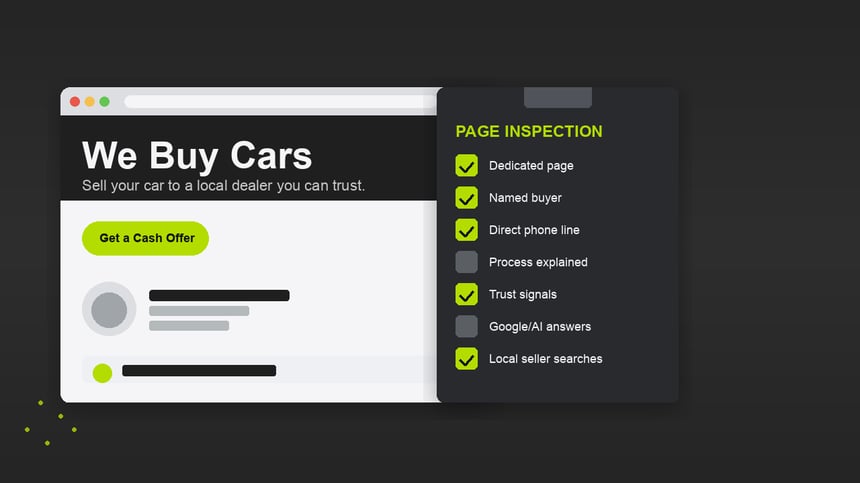
1. It says, on its own, that you buy cars from private sellers. Not “trade your car.” Not “value your trade.” Not “instant cash offer.” A real, dedicated page with a clear, plain headline at the top — “We Buy Cars in [Your City]”, “Sell Your Car to [Dealer Name]” — that a seller and a search engine can both read in three seconds.
That top line matters because a seller shouldn’t have to hunt, and Google shouldn’t have to guess. On many dealer sites, the easiest win is adding a few hundred words from your store: who handles purchases, how the offer works, when the seller gets paid, and why a local seller should trust you. Keep your valuation tool. Just don’t make the tool the whole page.
2. It puts a name and a face on the buyer. A photo. A name. A role. “[Buyer Name] runs our acquisition team. They’ve been buying cars in [your city] since [year].” This is the equivalent of the “meet our service team” page — and it does the same work. The best examples we saw added a short, friendly video of the buyer walking through the process. That single asset lifts trust on both the human and the AI side, because AI engines can cite a real person when asked “who buys cars at this dealership?”
3. It publishes a direct line — not the main switchboard. A dedicated acquisition phone number anchors the whole experience. Many dealers already pay for one — a buy-center direct line, a tracking number, a vanity number, or a managed line set up specifically for this work. The simplest opportunity is making sure it shows up prominently on the “we buy cars” page, in the footer, and in every seller text and call.
Quick test: have you ever Googled the number of a text or call you didn’t recognize? Of course you have. Sellers in your market do the same thing the moment your buyer reaches out. Now imagine the seller searches that number and the very first result is your dealership’s page — with your buyer’s photo, your “why sell” message, your address, and your reviews. Trust gets built in five seconds, before the buyer has even said hello on the follow-up call. That is the win.
When the number isn’t published anywhere — or it’s the same line that answers parts and service — that search comes up empty or, worse, surfaces a spam-call database. The seller hesitates. You lose the appointment before you knew you had one.
Want to know what a seller sees when they search your acquisition number? Send us your page and the number. We’ll include it in the free PDF. Get my free sell-my-car page check.
4. It explains the process clearly. How do I get an appraisal? What do I bring? When do I get paid, and how? What paperwork is involved if I still owe on the car? Four short bullets. Specific. Honest. This is the part most dealer process pages skip, and it is the part sellers read first.
5. It says what you actually are. A real local business. With an address, a service department, a parts department, a name above the door that’s been there since whenever. The longevity is a marketing asset most dealers leave on the floor. When a seller is comparing you to a national consumer brand they’ve seen on TV but never met, your continuity is the differentiator. Put it on the page.
Want us to run your page against these five? Send your website address. We’ll show you which boxes you’re already checking and which are the quickest wins. Get my free sell-my-car page check.
The CarMax and Carvana comparison worth putting in writing
Private sellers are already comparing the local dealer experience with national buyer brands. The opportunity is to answer that comparison in the seller’s language: payment clarity, local accountability, title and payoff help, and a person they can reach after the sale.
Payment. According to their published seller processes, CarMax pays sellers with a bank draft drawn on its corporate account, and Carvana offers a printed check or ACH direct deposit. Those are legitimate payment methods, and the seller’s bank controls when the funds actually clear in all three cases.
The dealer advantage is not “better paper.” It is clarity, speed, and local accountability — if your store can deliver them. If you cut a same-day check, say it. If you use a local banking relationship, say it. If payoff or title questions are handled by a person inside the building, say it. The goal isn’t to compete on slogans; it is to give a seller a reason to choose the local store on the merits.
Local accountability. A national brand can advertise convenience. A local dealer can offer something different: a named buyer, a title office in town, a service department, a building the seller can return to if a paperwork question comes up. That comparison, written down, is a strong sell-side page on its own.
Longevity. A dealer whose name has been on the building for decades — in some cases 90 or 100 years — has a continuity story national brands usually cannot match: local staff, local title help, local service, and a place to return if a paperwork question comes up. Put it on the page.
CarMax and Carvana have built real businesses with real strengths. The point isn’t to argue against them. It is to give a private seller a clear, honest read on what a local dealership offers that a national platform doesn’t — in writing, on your site, where a search engine and an AI can also see it.
Payment policies change. If you publish a comparison page, verify the current language at the source before you ship.
How search engines and AI tools read your buy-side presence
While the seller is reading your site, AI search tools like Google’s AI Overview, ChatGPT, and Perplexity are also answering questions about your store — sometimes in the same browser, on the same screen, ten minutes apart.
Keep it simple. Google and AI tools need the same things a seller needs:
- Real, plain-English content on your own page. A “we buy cars” page with real copy from your store is what gets surfaced. A third-party tool sitting in a window on the page mostly helps the tool’s brand, not yours.
- Answer the question in the first sentence. “Yes — [Dealer] buys cars from private sellers in [City]. We’ve been doing it since [year].” AI tools look for that directness. Burying the answer means the tool moves on.
- Make it easy for Google to see who and where you are. Include a clear business name, address, phone, hours, and a few simple Q&As (“How do I sell my car to [Dealer]?”, “When do I get paid?”). These help Google summarize your page accurately. Most dealer website providers can add this in a few clicks; if yours can’t, your web vendor will know what to do.
- Use local language. “Sell your car in [city]” in the page title and body — not “instant cash offer.” The seller searches in their own words; match them.
- Proof from real customers. Google reviews that mention selling a car. A complete Google Business Profile. Helpful mentions on community sites, Reddit, YouTube, and local pages. These tools tend to trust the same proof people trust.
Want to see what an AI tool says about your store? Type “Does [your dealership] buy used cars from private sellers?” into ChatGPT or Perplexity right now. If the answer is wrong, vague, or missing your own site from the sources it cites, the fix isn’t a coding problem — it is a content opportunity, and it is one of the more rewarding pieces of marketing work a dealer can do this quarter.
If the answer is off, send us the URL and the prompt. We’ll include the live AI answer and the recommended fix in your audit. Get my free sell-my-car page check.
The 10-point sell-my-car page playbook
You can run this on your own site tonight. Take screenshots. It is meant as a self-audit, not a scorecard — each item is an opportunity if it’s not already done.
1. Is there a dedicated “we buy cars” page on your dealership website? A page with its own web address that tells the full “sell us your car” story. Someone selling a car outright has different questions than someone trading while buying.
2. Is most of the page actually your content — or is it mostly a window into someone else’s tool? Third-party valuation tools are useful, but they shouldn’t be the entire page. If a seller landed on your page without that tool loading, would they still find your team, your offer, your process, and your story? If not, the page is working harder for the tool’s brand than for yours.
3. Can the page answer the five seller questions in your own words, on your own page? Do you buy cars from the public? Who handles it? How does the seller get an offer? When and how do they get paid? What happens with payoff or title?
4. Is a named buyer on the page — photo, name, role? Sellers want to know who they’d be talking to. AI engines want a person to cite.
5. Is there a dedicated seller phone number that routes to the right person? Use the same number on the page, in seller texts, and on outbound calls. When a seller searches it, the results should point back to your dealership — not to an unknown caller or spam-listing site.
6. Google that acquisition number. What’s on the first page of results? Your store? Spam databases? Whatever a seller would see in the next 60 seconds is the trust verdict.
7. Is the selling process explained — start, appraisal, payment, paperwork? Four short bullets is enough. Vague is worse than absent.
8. Is there a “we’ve been here since” line — and how prominent? If your store has been local for decades, that should be in the first screen of the page. Not the footer.
9. Does your site say anything about how selling to you differs from the national consumer brands? Payment method, local presence, accountability, recourse. Even one paragraph is more than most dealers have.
10. Open Google and type “does [your dealership] buy used cars from private sellers?” Does Google’s AI Overview answer at the top of the page? When it does, are the sources it lists from your website — or from competitors and third-party sites? If the AI is quiet or pointing somewhere else, that’s a content gap your team can fix, not a tech problem you need to wait on.
Each item is either a green check or an open opportunity. The point isn’t to count failures — it is to identify where a few hours of work would compound for years.
Want us to run all 10 checks and send back screenshots? Send us your URL. Get my free sell-my-car page check.
Make your website the cleanest seller lead source
First-party seller leads are the cleanest acquisition channel because the seller came looking for you — not a marketplace reselling the same intent to multiple buyers at once.
They carry less vendor cost. Less source confusion. A better chance to set the appointment before the car is already being shopped everywhere else. Your CRM will show the truth — compare first-party seller leads against sourced leads on contact rate, appointment-set rate, show rate, buy rate, and acquisition cost. If your own site doesn’t win that comparison, the answer is usually the page, the offer, or the follow-up.
The “why sell” message is the entry point to that channel. It is the cheapest, most durable, most defensible piece of acquisition marketing a dealer can build. It compounds. The hours you put into it this quarter still pay you four quarters from now.
The upside shows up in inventory, not just rankings
To size the opportunity, we recently matched inactive private-party listings against later competitor inventory in a conservative multi-store sample. We counted only VINs we could verify, and excluded own-lot matches, dealer cross-posts, and likely curbers.
The result: 186 vehicles later appeared on competitor lots. At a $2,500-per-vehicle gross placeholder, that represents roughly $465,000 of potential private-party gross in the sample alone.
That does not prove a better page would have won every vehicle. It proves the pool is large enough to justify fixing the owned channel first. Even a small lift in first-party seller capture can pay for this work many times over.
Get my free sell-my-car page check
Send us your dealership’s website address. We’ll run the same structured look we used to ground the conversations at the NCM 20 Group sessions — across four sections (Seller Experience, Google/AI Visibility, Trust Signals, Competitive Comparison) — and send back one PDF per store showing:
- what a private seller sees on your site;
- what search engines and Google’s AI Overview say about you;
- whether your acquisition phone number looks credible to a seller cross-checking it;
- how your sell-my-car message compares against the national buyer brands;
- the first three opportunities to capture, in priority order.
Just the read — a clear, store-specific look at what’s working and where the easy wins are.
Get my free sell-my-car page check or call 855-952-4949.
If your site is already clean, we’ll say so. If there’s room to capture more sellers, you’ll know exactly where to start.
Analysis drawn from VAN’s structured web-presence inspection of 33 dealerships ahead of two recent NCM Acquisition 20 Group sessions in partnership with VINCUE. The sample is anonymized and used to illustrate market-wide patterns, not to evaluate individual dealerships. CarMax and Carvana payment-process details are summarized from each company’s public help pages and may evolve — verify before citing in your own materials. The lost-opportunity figure is a minimum provable count based on VIN-trackable inventory; consumer marketplaces that hide VINs are not included.
For the full playbook on staffing and running the private-party channel, read how to build a dealership buy center, or skip the hire with VAN Managed Buyer™.